Tuesday, June 12, 2018

R/G Revel in the Overgrowth

In the deep tangles of the overgrowth, far away from where people live, various nature denizens absolutely luxuriate in the wild growth of the plane of Guthreham and don't want to be restrained. Some of the sentient races like dryads can feel the growth and grasp the energy being pushed up from somewhere deep within the plane. But they don't know that the plane is "pregnant," and don't care. They just like the way nature reacts to it and the strength it grants them.

So red-green is all about embracing the mutate mechanic and becoming monstrous beaters. Not exactly an unfamiliar role of the two colors. Admittedly, I find this color pairing generally uninspiring, though I did end up liking how the dinosaurs worked out in Ixalan. The enrage mechanic had more gameplay to it than I recognized on paper.

So, some creatures designed for the R/G mutate archetype.


This is a mutate version of a riff on a fun thing to do with enrage in Ixalan. Yes you can use this to kill an X/1 or ping your opponent. But you can also ping one of your own creatures with mutate and even the lizard itself to give it a +1/+1 counter.


I almost absurdly put this as a common. Yeah ... no. I'm gonna have to be careful about granting unblockability in the set.

While iterating some cards for this I began realizing that green's "ramp" identity is very different in this set. It's not about getting out lands and mana-producing creatures to get out big beasts. It's about getting beasts out and then making them grow larger. So there may be a little more emphasis on enchantments and targeted/activated abilities and a little less on getting more lands out.


Now that I'm settling on pairing archetypes I'm also keeping in mind cards that can bridge between color pairings to be versatile in limited formats. The Bonfire Furiant works well in both the red/black reave decks, and if you use this ETB effect on a creature with mutate, it's quite effective. It will get the counter before the effect is resolved. So if you use the ability on the Warproot Dryad, she'll get the +1/+1 counter for being targeted, and then she'll get +2/+0 when the ability fully resolves, making her 4/2 until the end of the turn.

Also, I have no idea what the hell a "furiant" even is. I just wanted some weird angry word to represent a fire elemental.

And the signpost uncommon for Red-Green:


This is another one where I'm not sure about the strength level. Until I playtest it's hard to predict how frequently we can expect a creature to get a counter in a given game. I have a feeling this is probably going to be fine in limited, but I wonder about it in constructed.

Monday, June 11, 2018

U/R Race You to the Bottom

So after experimenting with a couple of cards that reward you for scrying cards to the bottom, I kind of ended up thinking about the idea that the wizards in both blue and red are the ones who understand that something is really wrong with Guthreham and all the growth and the ones who have isolated themselves (either up in Nightscrape Mountains or on the Runetide Flotilla) to research.

Thematically, I started thinking that this manipulation with scrying could be a neat little theme for a blue-red identity to mechanically represent the relentless push to find answers. It's tough to do anything new and interesting with the color combo because of its tendency to focus on spells over creatures (unless you go tribal with them).

So as I stared at it, I realized that technically Snap Spark could be mono-red. Red can scry, though typically it doesn't get as much as other colors. Since blue is primary in scry, I can sort of bend it by making sure they work best together.


Note the cost drop. I realized that when it was two mana it would likely feel very bad if you really needed both cards and didn't put either of them on the bottom. If I kept it red-blue, I'd probably bump it up to scry 3.

Cheap blue Opt substitute:


I worry this one also feels bad if you don't put both on the bottom and get the card draw. I could bump up the cost and have the player draw a card for each one they put on the bottom.

There are elemental shaman folks on the flotilla helping keep tabs on the environment so everyone stays safe:


Note the "leaves the battlefield" trigger instead of death. So they scry if they get blinked or bounced.

And my stab at an uncommon signpost creature for the duo:


Might possibly be too strong for uncommon. But Dominaria really raised the game for signpost uncommons.


Possible New Mechanic: Fecund

So I tossed out one of my partnered animal cycle templates for feedback over at Goblin Artisans and a couple responses suggested it would have memory issues (true) and would create removal pressure (also true) too soon. Another suggested using a counter that would be removed to create a second creature, which is a problem for a set with a heavy focus on +1/+1 counters. So that's out.

But both responses got me thinking about other ways to gatekeep making creature tokens. The more I design, the more I realize token creatures are a vital, central part of the set that need a mechanic. I didn't want to use populate, but I really needed a way to show quick reproduction. I keep using the word "fecund" and realized, "Hey, that could be a mechanic."

So a way of triggering creature token reproduction has been bouncing around in my head all day (While I'm supposed to be working, no less.) I have two versions so far.

Version One:


So the way it works, is when this enters the battlefield, if you control another snake, you get an additional copy of this creature. The token copy does not have fecund because this is an enter-the-battlefield effect and would therefore immediately go infinite.

An alternate possibility representing wild, magical cross-breeding is this one:


In this version, when Thistle Adder enters the battlefield, if you have any other creature with the fecund ability, you get another snake. The idea being that the Thistle Adder breeds with the other creature.

I think this second version is more interesting, thematically more resonant with the set's concept, and keeps it from drifting too tribal. It would go great with green-blue concepts of quick evolution I'm trying to brainstorm. On the other hand, it's a bit creepy (we are talking about interspecies sex here) and keeps it from being used on humanoid creatures (because we are talking about interspecies sex). That's maybe okay. There will be other spells that can make humanoid tokens.

I see this in being in green (snakes and spiders), white (hounds and birds) and blue (birds and perhaps some sea creatures). I'm thinking of keeping it very, very limited in red and black. Maybe just a couple of red lizards and only black rats. Even though the vermin theme in G/B loves this mechanic, black already has access to a lot of mutate and reave. Black is getting maybe too many things in this set.

Oh, Hey Look. It's Reave!

So I've been fretting all this time about whether Reave was just too parasitic to work in a set that wasn't heavily focused on graveyard shenanigans.

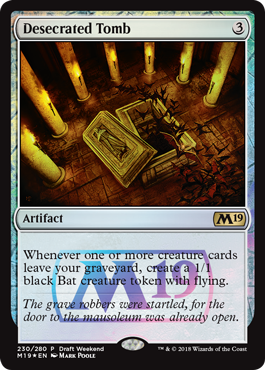
Today is the start of spoiler season for the new Core set, out in July. Check this out:


It's Reave! It's unkeyworded and not entirely exactly the same, but the central mechanical concept is there: Something is triggered when a card leaves your graveyard.

It's interesting that this is a rare. I wonder how much creature recursion is in the core set? There must be quite a bit if they're worried about people getting too many 1/1 flying bats that they've put this as a rare.

The Desecrated Tomb is similar to one of my concepts for Amonkhet-themed version I did for the Goblin Artisan GDS3 exercise. I visualized Temmet (the U/W embalm lord legend) returning as a W/B mummy leader. Whenever a card left your graveyard you'd get a 2/2 white zombie.

Sunday, June 10, 2018

The Runetide Flotilla and Defensive U/W

While the green-white coalition is ensconced in the Arbor trying to keep the beasts and overgrowth at bay, those who lived off on the fringes of society ended up getting pushed further and further toward the coasts. With little room, some started building a flotilla of ships and rafts to live on to both stay away from all the animals and try to stay isolated from disease.

This over years ended up growing and growing in size and population until it became a small city of its own, now known as the Runetide Flotilla. This is how blue-white will be represented in the set.

The theme here is of a very defensive, reactive posture meant to keep big creatures at bay with the two colors' emphasis on control abilities. Then the win comes from its evasive flying creatures.

Nothing terribly pioneering in the ally's nature in this set. But that's okay--not every color in a Magic set gets to go bonkers.

Particular to this set is that these two colors will have an emphasis on really shutting down large creatures. It is intended to be strong against mutate-heavy decks, but vulnerable to other decks that go wider than it does (like the green-black vermin deck) and it will be probably more vulnerable to spells as it will be focused so heavily on controlling opposing creatures. (Though of course blue can always splash in some counters).

Some card concepts:


I kind of go back and forth as to whether this is common. Detain is much more powerful than tapping, but it's also conditional. I think this can be common. I want it to be common.

And yes, I know this is actually flavored for The Arbor. But you'll still be drafting this in White-Blue.


Note that with this enchant and with the the pikeman, targeting a creature with mutate will immediately give it a +1/+1 counter, so there's some interesting interactions. Every time the pikeman detains a creature with mutate, it will get a counter. If the pikeman leaves the battlefield, you might be in some deep trouble. Also maybe the pikeman should be 3/1?


A win-condition card for white. Note that creatures that have been detained or are otherwise unable to attack can still contribute to the angel's triggered ability. She's intended to help you stabilize if you're confronted with big beasts.


Very simple variation on blue unblockability.

I've tinkered with the bird lord, which is also the signpost uncommon for blue-white:


A bit of a wonky ability. I wanted to make it clear that this color combo is not about going tall, but rather taking the high route. I don't like the activation cost, but given that it's uncommon, it seems like it's necessary for a repeat trigger.

Saturday, June 9, 2018

Cephalids, Xirn and U/B Identity in Overgrowth

So I was very, very disappointed that cephalids not only didn't appear in Dominaria at all, they aren't so much as referenced in flavor text or even in the story. It's not even clear if their kingdom still exists (and Mark Rosewater was typically cagey about when asked). There's still merfolk, but we don't know of their rivals are still around.

So for our participatory version of GDS3's tribal challenge over at Goblin Artisans I picked them to try to iterate a concept of how I actually want cephalids to play in Overgrowth. I technically picked "octopus" as my tribe. I'm taking a page from the way Wizards of the Coasts deals with avens and khenra from Amonkhet and referring to them by their animal roots rather than their race. Octopuses are a recognized creature type. Cephalids are not.

I am actually pretty happy with how the exercise turned out. And while I don't intend them to be played as a "tribe" in Overgrowth like the challenge required, the exercise helped me figure out the goal for U/B gameplay. It draws on black and blue's shared interest in manipulating cards outside the battlefield and playing cards from places other than the hand. And even from playing opponent's spells. We're not going with the Amonkhet/Innistrad creature recursion method. But rather, reusing sorceries and instants or using your opponents' spells.

So here's my new "signpost" creature for blue-black.


In the tribal version, the damage scaled based on octopuses in your graveyard (I kept the desperate, disease-afflicted identity of them for this exercise). In this case, I want to go with a mini-drain. I may want to tweak the numbers based on testing. Since the concept behind gameplay is so control oriented, they need a way to gain life.

Speaking of control:


So if you cast Xirn's Rebuke and copy a spell and you have Blightcoast Reaver out, it will trigger the Reaver's life drain.

Figuring out what I want for the cephalids' playstyle also meant rethinking Xirn as a planeswalker:


Part of me thinks that +1 is too powerful, but have you seen Teferi?

(Edit: Just realized his ultimate needs to be able to use any color mana to cast the spells in order to work properly.)

Black's version of board-clearing in this set is also tied to the cephalids:


I need to be careful about black sacrifice outlets in the set. I currently don't have any. I'm sure there will be some, but I need to make sure they can't be triggered multiple times in a turn.

There's also going to be some design tension here between U/B and B/R. These guys want to reuse spells in graveyards. R/B wants to exile cards from graveyards to trigger effects. I don't want to pull black in too many directions because that can cause problems in limited. I think that's what's happening with red in Dominaria. Too many different play dynamics based on what color you pair it with and the creatures just don't synergize well. So red ends up being one of the weaker colors in limited formats.

Rethinking Reave

Over at Goblin Artisans we're all invited to do our own entries for the Great Designer Challenge 3. For the challenge to create a new mechanic, I brought in Reave, but I changed the way it worked. For that challenge, rather than being a graveyard version of Revolt, it was a passive ability on the card that triggered when it left the graveyard.

An example:


If anything, I made Reave even more parasitic, and I knew that. I made this variation with the idea that it would be part of a set with a graveyard manipulation theme. In this case, I conceived the mechanic as part of a return to Amonkhet.

But Overgrowth is not a set with a theme of graveyard manipulation, and so the mechanic needs to be much more accessible. I was still feeling that the version that I've been fiddling with here is still too parasitic to function, especially in a limited setting. So instead of it just being something to check, it's something you can trigger when casting. My current version of Reave for this set looks like this:


What about this instead?


Essentially Reave becomes a variant of Kicker, giving you the opportunity to pay the cost as part of the spell.

Note how I've worded the damage boost so that it doesn't say "If you've paid the Reave cost." That's deliberate. So you can pay the Reave cost on one spell during your turn and then all spells you cast that turn that check for the graveyard-exit condition will get the bonus. This means recursion to your hand or battlefield will also work. It also means that you can create combo dynamics--other spells and abilities that remove cards from your graveyard that aren't specifically Reave costs will trigger the second ability.

So my dragon for the set currently looks like this:


But it could instead just be this:


Fundamentally, it operates the exact same way. I'm just taking the ability word away because it's no longer necessary. Reave is now a type of additional cost action, not an ability word. I think this is both a more elegant presentation and also a way to manifest it at common more easily.

I have two templates here, though, one that allows for land cards to trigger it, and one that excludes them. I'm not really sure which one I want to use. I'd have to playtest. My natural inclination is to exclude lands, because that tends to be the habit in card design (lands aren't spells and they have no casting costs and it can be a gameplay problem to exile/destroy/discard them). But I'm not sure it's relevant in this context.